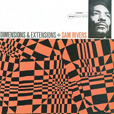
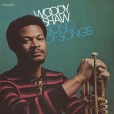
Shepp’s Impulse! debut, co-produced by Coltrane and featuring four of his compositions, arranged for four horns, including Wayne Shorter’s brother Alan, John Tchicai, and the one and only Roswell Rudd.
Stewart Smith in The Wire: ‘Jeff Parker and his ETA IVtet go deeper into the hypnotic minimalism that made its predecessor Mondays At The Enfield Tennis Academy a highlight of 2022. Parker’s recent music represents one of the most sophisticated applications of hiphop language into jazz, whether he’s playing over beats and loops or imitating their feel in real time. Parker and the ETA IVtet have their groove down to the point where it’s no longer fusion but a fully integrated sound, drawing on the unquantised beats of J Dilla and Madlib, and the time stretching strategies of psychedelia, krautrock and dub.’
Likely recorded in Chicago around 1956; originally released on Saturn. Ra is co-composer of both sides; it could be him playing the harmonium.
‘I had two main vocal groups at the time,’ Ra once recalled. ‘One was called the Cosmic Echoes. And the Cosmic Rays, too. It was around the same time that John Gilmore joined the band. I saw the possibility that they could be really great so I began to coach them; they were connected with a barber shop, but I taught them other things.’ ‘We’d go down to the barber shops and rehearse some groups,’ added John Gilmore. ‘Sun Ra had them singin’ some beautiful stuff. I think he probably was saving them from themselves. He heard them, heard their potential, snatched them off the street, and started making them do something constructive.’
Combining two BBC Radio sessions, recorded at Maida Vale Studios in 1973 and 1978, with Norma Winstone, Henry Lowther, Art Themen, Tony Coe, and the gang.
Eight Garrick originals, including favourites from the Troppo and October Woman LPs, and an early, first showing for River Running and Galilee. Robin’s Rest only appears here.
‘Fabulous,’ says Record Collector.
This expert drummer spent long stints with Archie Shepp and Sam Rivers; and he’s played with scores of other jazz greats, like Mal Waldron, Charles Tolliver, Yusef Lateef, Billy Harper, David Murray, and so on. He toured Europe with Marion Brown in 1977 — recording La Placita live in Willisau — and the following year cut Wooley The Newt for the saxophonist’s Sweet Earth label. His son Makaya sampled it recently on We’re New Again, his Gil Scott-Heron rework.
Free, grooving, spiritual jazz. Check it out.
A classy, rock steady sextet — the rhythm section is Art Taylor and Paul Chambers — presenting four compositions by Mal Waldron.
‘Sangam means ‘meeting place’ in Sanskrit. Don obviously knew exactly what he wanted to do, and Latif immediately understood, his fingers fizzing across the tablas at frightening speed… It was Don who suggested that Latif overdub new tabla parts to enrich and add complexity to the first takes. We could reasonably have expected to spend the night doing this because this was the first time the percussionist had done this. It took him all of five minutes to get used to listening to the first tracks over the headphones before playing them without the slightest mistake. When we got to the timpani, which he was playing for the first time, his keen sense of pitch and tone once again did miracles. During one take, just for the fun of it Latif started to play a fairly slow, disconnected duple time, moving on to three and then four… all the way up to 19 by which time his fingers were whizzing invisibly across the skins, leaving us in awe and him looking as if he didn’t know what the fuss was all about. All this just made Don even keener to impress his musical companion for a day…
‘Of course, the subtleties of this album call for greater analysis, for example the meeting between the Malian doussou n’gouni and Indian tablas, the Hammond organ taking over from the tampura, 5 1/4 time as if it were the easiest thing in the world, the reinvented Indonesian gamelan… and the lyricism of the pocket cornet.’
Recorded one long hot night in July 1978.
Sun Ra at the Rhodes, Disco Kid on guitar… Deadly funk, heady and grooving. A stone classic.
The new box set features the original LP alongside alternative mixes by Bob Blank first released in limited quantities for a 1978 Arkestra gig at Georgia Tech. Both versions of the album are cut loud at 45 rpm over 2LPs each.
Housed in a silver foil box, as per the original issues the first LP comes in a foiled sleeve while the second features two yellow A4 sheets pasted onto a white sleeve. With a twelve-page booklet featuring previously unseen photos and various texts.
The CD version is housed in a foil digipak.
The single LP is a straightforward reissue of the original LP.
The title track was ‘one of Sun Ra’s on-the-spot compositions,’ recalls Danny Ray Thompson. ‘Almost like an Ancient Egyptian Stargazing Ceremony, mapping out the stars and the planets.’ Where Pathways Meet is his ‘funky version of an Egyptian march. Pharaoh is sending his troops off to fight and this is his pep-talk! The music seems to take different pathways but still converges.’ The loping groove of That’s How I Feel features the reflective trumpet lines of Eddie Gale, with solos by John Gilmore, and Marshall Allen on ‘snake charming oboe’. The funky Twin Stars Of Thence weaves around Richard Williams celebrated elastic bassline; the haunting closer There Are Other Worlds is pure ‘space music’.
With Idris Muhammad, Bobby Watson and James Spaulding in 1983 (when the trumpeter was gigging for Archie Shepp and Frank Wright). Glowing, spiritual jazz, featuring the jazz dance classic Brotherhood.
From 1964, a fresh, invigorating, up-for-it, personal take on happening US jazz — Coltrane in particular — blending in themes from Polish folk music. Try the rollicking Piatawka, with its evocation of highlander bagpipes. Scorcher!
Multi-instrumentalist Namyslowski was an alumnus of Krystof Komeda’s ground-breaking quintet. In the early sixties, he formed the Jazz Rockers with Micha Urbaniak, and in 1962 both joined The Wreckers, playing the Newport Jazz Festival. In 1964 his own Modern Jazz Quartet toured throughout England, Scotland, and Wales. “We had songs like Piatawka in the programme, inspired by Polish mountain folklore… These were the forms that had never been heard there before… Not only was I a musician from behind the ‘Iron Curtain’, but it also turned out that this musician had his own voice and showed something innovatory.”
Pianist Wlodzimierz Gulgowski plays a blinder, too; nodding to both Chopin and Mal Waldron. (A decade later he hooked up with Urbaniak, for the LPs Fusion III and Funk Factory.)
Lola was recorded in London; produced by Mike Vernon, who founded the Blue Horizon label, and produced Fleetwood Mac and David Bowie, amongst others. For the cover shot, Decca commissioned the same photographer as for the first Rolling Stones LP, to follow suit. “We are in the same sweaters from Marks & Spencers, only each in a different colour.”
A gorgeous reissue of his first LP, from 1957; with Curtis Fuller, Hugh Lawson, Ernie Farrow, Louis Hayes, and Doug Watkins. Beefy, alive, and exploratory, with Lateef’s Eastern trajectory flagged already, in the thrilling argol introduction to the opener, Metaphor. On the flip, Morning is ravishing, unmissable Lateef.
Portrait In Jazz and Explorations by the almighty trio with Scott LaFaro and Paul Motian.
Sparklingly remastered, adding twenty-six alternates and out-takes, mostly unreleased; handsomely packaged.
In its full-length glory, from the great man’s 1980 LP Journey To The One; plus his version of the Marvin Gaye classic, from his 1978 LP Love Will Find A Way, with Norman Connors.
Both recordings luxuriating on 12” for the first time.
‘Classic Vinyl Series.’