Your basket is empty


Omniverse — Sun Ra
Hartmut Geerken and Chris Trent
Art Yard
Over three hundred pages: numerous previously-unpublished photographs of Sun Ra and the Arkestra by Hartmut Geerken and Val Wilmer; a fully revised discography by Chris Trent, co-author of The Earthly Recordings Of Sun Ra; articles by Amiri Baraka, Chris Cutler, Robert L. Campbell, Salah Ragab and others; and newly gathered, full-colour images of hundreds of Sun Ra album covers, posters, handbills and ephemera, including reproductions of rare, hand-drawn, hand-coloured LP sleeves.
French fold cover, metallic foil blocking on cloth, hardback; 290mm x 245mm.
Fab. Pricey, but it’s a must, let’s face it (and Amazon has the previous, inferior edition for a grand).

From 1979, and including UFO — rumbustious disco, Arkestra-style, featuring Marshall Allen on oboe, with solos from John Gilmore, Taylor Richardson and Michael Ray (who also mixed the album, layering in pre-recorded material).
Seductive Fantasy lines up John Gilmore, James Jacson’s bassoon, some fine baritone saxophone and some electric guitar and bass, Marshall Allen’s oboe and Eloe Omoe’s bass clarinet, with great piano-playing from Ra throughout, and towards the end some arco strings.

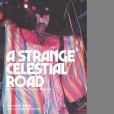
From the same 1979 recording sessions as Strange Celestial Road, this is one of Sun Ra’s best-loved, funkiest records, with John Gilmore in full flight, and a bigger Arkestra than had just played the Moers festival.
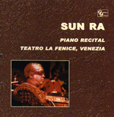
Live at Teatro la Fenice, Venice, November 1977. From the same tour that produced Disco 3000 but this is a different cup of tea. Thoughtful solo piano. Limited edition.
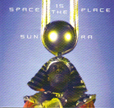
The LP is in the ‘Verve By Request’ series.
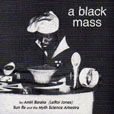
Those Christmas records just keep on coming.
This one’s a Jihad, originally, featuring Leroi Jones on a mission.
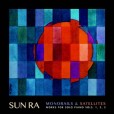
The two Saturns, from 1966; plus a third, previously-unreleased volume of five originals and four standards.
‘More of a collection of statements than a style. Some of the tunes, with their odd juxtapositions of mood, could be mistaken for silent film scores. Perhaps they were audio notebooks, a way to generate ideas which could be developed with the band. Regardless, they serve as compelling standalone works. The fingering reflects Sun Ra’s encyclopedic knowledge of piano history as his passages veer from stride to swing, from barrelhouse to post-bop, from march to Cecil Taylor-esque free flights, with a bit of soothing candelabra- swank thrown in. Sunny’s attack is mercurial, his themes unpredictable. His hands can be primitive or playful, then abruptly turn sensitive and elegant. As with the whole of Sun Ra’s recorded legacy, you get everything but consistency and predictability.
‘The listener also experiences something rare in the omniverse of Sun Ra recordings: intimacy. His albums, generally populated by the rotating Arkestral cast, are raucous affairs. With the Monorails sessions, we eavesdrop on private moments: the artist, alone with his piano.’
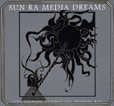
Sun Ra (piano organ, moog, rhythm machine, vocals), John Gilmore (tenor sax, drums, vocals), Luqman Ali (drums, vocals), Michael Ray (trumpet, vocals) — the companion to Disco 3000.
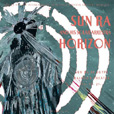
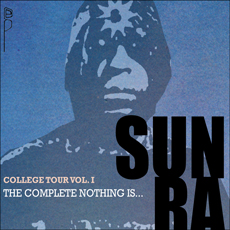
The 1966 live LP augmented by more than ninety minutes from the same five dates.
All three volumes, with each disc enhanced, containing archival photos, critical writings and historical videos, including the eighteen-minute documentary Sun Ra Spaceways.
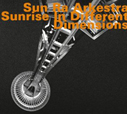
A nonet Arkestra live in 1980.
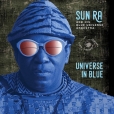
From 1972, with Ra on organ throughout — trading solos with Gilmore and trumpeter Kwame Hadi on the bluesy title cut; duetting with drummer Luqman Ali on In A Blue Mood. June Tyson stars on Blackman.
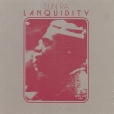
Recorded one long hot night in July 1978.
Sun Ra at the Rhodes, Disco Kid on guitar… Deadly funk, heady and grooving. A stone classic.
The new box set features the original LP alongside alternative mixes by Bob Blank first released in limited quantities for a 1978 Arkestra gig at Georgia Tech. Both versions of the album are cut loud at 45 rpm over 2LPs each.
Housed in a silver foil box, as per the original issues the first LP comes in a foiled sleeve while the second features two yellow A4 sheets pasted onto a white sleeve. With a twelve-page booklet featuring previously unseen photos and various texts.
The CD version is housed in a foil digipak.
The single LP is a straightforward reissue of the original LP.
The title track was ‘one of Sun Ra’s on-the-spot compositions,’ recalls Danny Ray Thompson. ‘Almost like an Ancient Egyptian Stargazing Ceremony, mapping out the stars and the planets.’ Where Pathways Meet is his ‘funky version of an Egyptian march. Pharaoh is sending his troops off to fight and this is his pep-talk! The music seems to take different pathways but still converges.’ The loping groove of That’s How I Feel features the reflective trumpet lines of Eddie Gale, with solos by John Gilmore, and Marshall Allen on ‘snake charming oboe’. The funky Twin Stars Of Thence weaves around Richard Williams celebrated elastic bassline; the haunting closer There Are Other Worlds is pure ‘space music’.
We ship worldwide. The postage rates for your order are displayed before payment, which is processed using Paypal. You can pay using your Paypal account or any of the following cards. No need to join Paypal.
