Your basket is empty


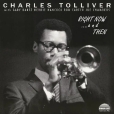
The first album in thirteen years by this great trumpeter (and founder of Strata East).
A quintet — with US veterans Jesse Davis, Keith Brown, Buster Williams and Lenny White — joined by Binker Moses on a couple of cuts.
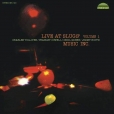
The great trumpeter with Cecil McBee, Stanley Cowell, and Jimmy Hopps, at Slugs’ nightclub in New York City, on May 1 1970.
‘Tolliver, McBee and Cowell (in that order) each contribute a composition to this superb, compelling set; though very much distinct, each is equally strong. Drought is the kind of dark-hued, well-honed burner which Tolliver routinely produced in his fertile years. Felicite is a more contemplative affair, a deeply felt and empathically performed piece. The unit here is in particularly sublime form, merging considerable skill with a staggering emotion. Orientale falls somewhere in between the pace of the two, with Cowell’s Eastern scales establishing an austere, industrious tone throughout its seventeen-and-a-half minutes.’

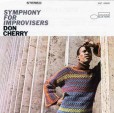
With Pharoah Sanders, Henry Grimes and Ed Blackwell, in 1966.
‘Sanders’ mix of Coltrane’s yearning long notes, Ayler’s ghostly, fluttering wail, Coleman’s fast, bumpy phrasing and his own manic bagpipe screams certainly separates the faint-hearted from the stayers on the opening Awake Nu. But the conversation between Sanders and Cherry is light, lyrical and engaging on The Thing, and the saxophonist even gets into a stubborn, Sonny Rollins-like repeating Latin vamp on There Is the Bomb. An unflinchingly quirky classic’ (The Guardian).

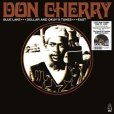
DC’s first album as leader, after leaving the Ornette Coleman Quartet. Two side-long suites, recorded in single takes on Christmas Eve, 1965. Bristling with creativity, rammed with great tunes and brilliant solo spots. Cherry plays cornet, alongside Gato Barbieri, Henry Grimes and Ed Blackwell. In the same year as his own debut as leader — The Call for ESP — Grimes is terrific.
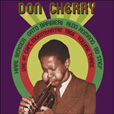
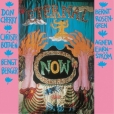
With Gato Barbieri, Karl Berger, Bo Stief and Aldo Romano, showcasing his new Blue Note album — still powerful, joyous, inspired.
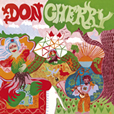
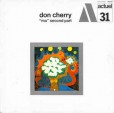
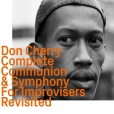
Numinous outernational jazz recorded in Stockholm in 1972 — DC originals, and covers of Terry Riley, Nana Vasconcelos, Abdullah Ibrahim, Pharoah Sanders and Leon Thomas.
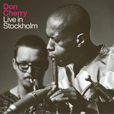
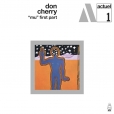
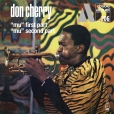
Previously unreleased music from 1968 and 1971 — with Maffy Falay, Bernt Rosengren, Okay Temiz, Torbjorn Hultcrantz, Tommy Koverhult, Leif Wennerstrom and Rolf Olsson.

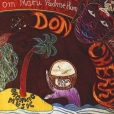
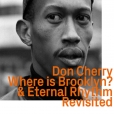
The Organic Music Society in super-quality audio, recorded by RAI in 1976 for Italian TV.
Ecstatic, bare-naked, free-as-the-birds music, with Cherry playing pocket-trumpet, the great Brazilian percussionist Nana Vasconcelos, the Italian guitar of Gian Piero Pramaggiore, and the tanpura drone of Moki.
‘A pure hippie aesthetic, like in an intimate ceremony, filters a magical encounter between Eastern and Western civiliziations, offering different suggestions of sound mysticism: natural acoustics in which individual instruments and voices are part of a wider pan-tribal consciousness. A desert Western landscape marries Asian and Latin atmospheres. Indigenous contributions with berimbau explorations find fossil sounds of rattles and clap-hands invocations. Influences of Indian mantra singing are combined with eternal African voices or with folkish-Latin guitar rhythms, while flute and drums evoke distant dances.’
Interviewing Shirley Collins recently, Stewart Lee noted how so many of her songs are ‘stories that go back hundreds of years, and that suggests there’s a continuity to existence, which means we don’t have to worry.’ Quite different music, obviously, but Om Shanti Om is the same kind of miracle medicine.
It’s a must.
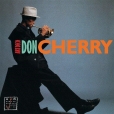
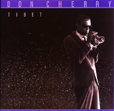
Good old-fashioned bopping out at Van Gelder’s in 1989 with chums Charlie Haden and Billy Higgins from early Ornette days; and sensationally bringing back Texas Tenorman James Clay, DC’s spar in late-50s California, and avowedly a key musical influence. It’s a celebratory, self-affirming set: three OCs, Bemsha Swing, a rootical solo Haden and a sparkling solo Cherry, Body And Soul, I’ve Grown Accustomed To Your Face… Look back in love. Everyone plays masterfully.
‘Verve By Request’.
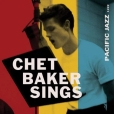
This 1954 vocal LP was the trumpeter’s idea. Pretty much everyone in the studio was sceptical, but Baker stuck to his guns during the numerous takes required to iron out his tuning. ‘I thought it was bullshit,’ recalled his close collaborator, pianist Russ Freeman. ‘Louis Armstrong and Jack Teagarden sang like jazz singers. This was ballads. Totally meaningless.’ Metronome magazine pilloried Baker’s ‘abysmal vocal deficiencies’, like ‘a four-month-old baby’s lack of coordination because he can’t walk.’
Punters loved it. The same year, audience polls in Down Beat magazine made him best trumpeter and best vocalist, above Miles Davis and Nat King Cole. This LP became his best-seller, over the decades. Its version of My Funny Valentine is arguably definitive.
The sexual and racial politics of its reception run fascinatingly deep. Baker’s ‘white’, ‘effeminate’ singing style demurs a throw-down with ‘expressive’, ‘black’ machismo. (Bob Dorough, Mose Allison, and Michael Franks are fellow travellers.) ‘A lot of people thought — foolishly so — that because of the way I sang, I, y’know, liked fellas or something,’ Baker once remembered, nervously. According to his biographer James Gavin, the album made him the first jazz musician with a ‘strong homosexual following’. Pacific Jazz producer Dick Bock’s marketing survey in 1955 found that most of Baker’s fans were women who wanted to hear him sing. It was a massive hit in Brazil, too, coursing into the bossa nova movement via admirers like Joao Gilberto and Nara Leao.