

Your basket is empty

Startlingly accomplished new jazz from South Africa, teeming with ideas, influences and idioms.
Maybe you remember Asher’s drumming on Angel Bat Dawid’s The Oracle.
Hotly recommended.
A terrific album by the Hen Ogledd conspirator, and collaborator with the likes of Derek Bailey, Bill Orcutt and Jon Butcher.
A telyn rawn is a harp strung with wound and pleated horse hair. (Tristram Shandy would have a field day.) It’s maybe a millennium old; passing into obscurity around two hundred years ago.
“All the music on this album is improvised. I designed and built a long forgotten instrument, engaged with historical texts and poetry, learnt the techniques and music from the Robert ap Huw manuscript and researched the importance of the horse and horse cults in Welsh culture. All these interventions were a means to improvise historically informed music and re-evaluate the legacy of the harp in Wales but ultimately served as a jumping off point so as to create new possibilities.”
The music is warmly compelling: polyphonic, convivial, rootsy, evocative, often mesmeric, sometimes banging.
Ancient Welsh folk veers into koto and kora, Appalachian dulcimer and Norwegian langeleik; the wheezing, wailing, rocking traditions of drones and sawing from Louisiana to Albania are streamed into the Valleys, and out again, changed.
Handsomely presented, too. Hotly recommended.
A knockout, proto-Pablo, rocksteady organ instrumental. Dandy Livingstone, surprisingly enough, riding east of the River Nile. Originally out on Trojan in 1968.

Conscious lovers — Paulette’s own upful, considered advice, delivered with fresh, youthful persuasiveness, and deadly horns. Another killer one-away.
Ace mid-seventies roots and dub. Doomily austere and on-point, with both piano and organ, crisp high-hats, and and wickedly effective backing vocals.
An unmissable one-away, produced and arranged by Denton as the solitary release on his own label.
Lovely, wheezing roots, with the same charming frankness and male vulnerability as Jux’ She’s Gonna Marry Me.
Great tunes to spin at wedding parties (cut with Pablo’s Bells Of Death).
Leroy Burgess & The Fantastic Aleem Brothers.
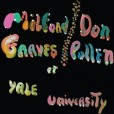
Bringing together two of the most prized, auratic LPs in all of free music, with music as vital and challenging today as it was more than five decades ago.
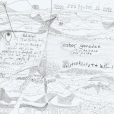
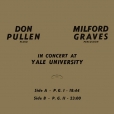
In Concert At Yale University, Vol. 1 was self-released on the duo’s Self-Reliance Program imprint in 1966. Copies are impossibly rare, especially the first few, which sported hand-painted covers by the musicians. (Several of these are displayed in the CD gatefold, together with a terrific photo of the pair selling LPs at a Nation of Islam convention.)
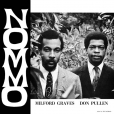
It was followed by Nommo, the next year.
For a performance at Yale University in New Haven, Connecticut, in spring of 1966, percussionist Milford Graves invited pianist Don Pullen to play duets. The two musicians had worked together in a band fronted by saxophonist and clarinettist Giusseppi Logan, with whom they had recorded two LPs in 1965 for ESP. Graves was already a daunting presence in free music. One step at a time, he was busy transforming the role of drumming in jazz, introducing a new way of dealing with unmetered time and accomplishing this task with technique that was almost inconceivable. His experience playing timbales in Latin bands had been formative, suggesting that the snare could be used as accent rather than beat-keeper, but by the mid 60s he’d worked up a holistic approach to sound and energy that was the most radical of his improvising percussion contemporaries.
For his part, this early setting finds Pullen at his most hard-hitting, and his pianism here lays to rest any allegations of Cecil Taylorism.
The basis of these works is a set of scintillating, widescreen improvisations by the Brussels-based pianist Pak Yan Lau (prepared piano, toy pianos, synth, objects and electronics) and Darin Gray (bass, preparations, objects and electronics), who has played alongside Jim O’Rourke for twenty years.
Over time Pak Yan added, layered, twisted, subtracted… including a recording of the underground tram in Albert, Brussels, for example. “I frequent this station all the time,” she says, ‘because my daughter goes to kindergarten there. One day there was an electricity problem, the whole station was humming, beautiful overtones coming out.”
“I liked the contrast between trudge (meaning you kind of move forward with difficulty and obstacles on your feet) and lightly (even in that situation doing it gracefully and lightly). The music on this record has that light/dark–ness.”
‘Mesmerising, fresh, inventive and intense,’ writes Stef Gijssels for The Free Jazz Collective.
‘A majestic feat in which she blends orchestral arrangements with R&B, jazz, broken beat and dub, resulting in a grand, nuanced record that feels airy and celestial without sacrificing the groove. It’s a deeply personal offering about her trek towards falling back in love with musical composition over the past four years.’
‘As well as pulsating modal workouts (The Seer), there’s real melodic beauty, too, from Set It Free (featuring London-based vocalist and trombonist Richie Seivwright) and We Walk In Gold (featuring Georgia Anne Muldrow) to the ethereal beauty of the instrumental Clarity. Garcia also reveals some lovely arranging touches — the way in which the Chineke! strings and guest vocalist Esperanza Spalding introduce album opener Dawn in free time, while the core trio of Joe Armon-Jones, Daniel Casimir and Sam Jones slowly introduce pulse in a gradual fade in; the dramatic strings-only coda appended to the epic title track; the fabulously rich string pizzicati which drive Water’s Path ever onwards; plus strings and sax ascending together in the all-too-brief Clarity (Outerlude)’ (Jazzwise).